| Level 1No AI |
Generative AI is excluded from the assessed task. Students are not allowed to use AI. |
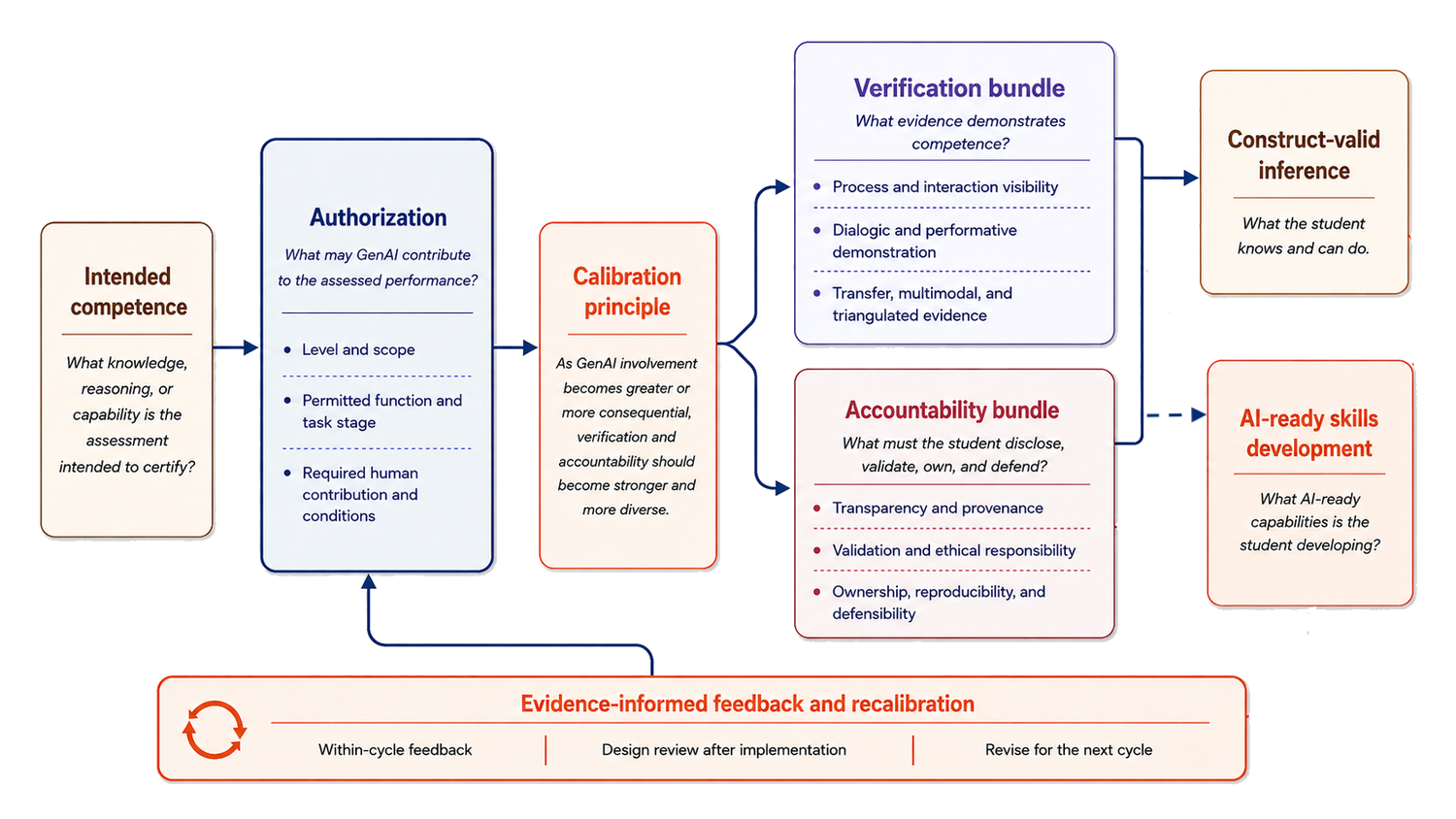
Standard supervision or in-class conditions. No further evidence is required beyond the assessed performance. |
Ordinary academic-integrity expectations apply. |
Foundational judgement: demonstrating independent thinking. |
| Level 2Ideation & planning |
AI supports brainstorming, structuring, and organization. Analysis and drafting remain the student’s own work. |
A planning note, source map, or brief oral discussion of central decisions. |
A short AI-use statement identifying the tools used and the purposes served. |
Directing and framing: generating productive prompts, selecting and organizing AI-suggested ideas, and retaining ownership of the direction of the work. |
| Level 3Editing & revision |
AI supports language, style, and revision. Core disciplinary decisions remain the student’s. |
Version comparison or revision rationale, and a brief oral spot-check explaining key revisions and disciplinary decisions. |
A record of accepted and rejected AI edits; independent fact-checking and source verification. |
Critical appraisal: evaluating AI’s language and style suggestions, accepting or rejecting them with justification, and verifying facts and sources independently. |
| Level 4AI completion, human evaluation |
AI generates substantial elements. The student selects, evaluates, revises, and integrates the outputs. |
Demonstrate competence through an oral explanation, parallel assessment task (assessment twin), or transfer task, supported by evidence of key decisions made during the work. |
Disclose how AI was used, check the accuracy and ethical appropriateness of its output, and accept responsibility for the final work. |
Evaluation and integration: judging the quality of substantial AI output, revising and integrating it selectively, validating its accuracy, and taking responsibility for the final result. |
| Level 5Full AI |
AI creates most of the content. The student guides it, checks everything, and explains the result. |
A real-time walkthrough in which the student explains, adapts, and justifies the work while demonstrating retained disciplinary capability. For example, AI may generate a campaign package, but the student explains and defends the key creative and strategic decisions. |
A clear record of how AI was used, and the student defends the work. |
Orchestration and governance: directing AI systems, critiquing and adapting their output, and ensuring reproducibility, ethical integrity, and accountability throughout the process. |